

Behavioral Health Data
Hospital and Workforce Behavioral Health Data in California
To better understand and respond to the growing behavioral health needs impacting healthcare services throughout California, HCAI offers a range of topical data products focused on behavioral health, which includes mental health and substance use disorders. These resources include key findings and trends that help inform strategies, improve program effectiveness, and promote health equity for all Californians.
Behavioral Health Data Product Refresh
See the latest update to demographic data on patients with a behavioral health diagnosis in California hospitals.
The Behavioral Health Hospitalization Landscape
HCAI’s behavioral health data highlights potential strains on the California healthcare system, as the prevalence of behavioral health diagnoses has risen in recent years. The National Institute of Mental Health reported that nearly one-in-five adult Americans live with a mental illness; in California, that equates to nearly eight million people. Over five million Californians, or 17% of the population, also meet the criteria for a substance use disorder (SUD).
This rising demand intensifies pressure on California’s behavioral health workforce, which already struggles to meet the need for timely, community‑based care. Inpatient (IP) stays and emergency department (ED) visits often become the default response when individuals face acute behavioral health crises due to gaps in community-based care, prevention programs, and outpatient services. In 2024, patients with behavioral health diagnoses accounted for nearly one third of all IP hospitalizations and approximately one eighth of all ED treat and release visits.
California Behavioral Health Insights
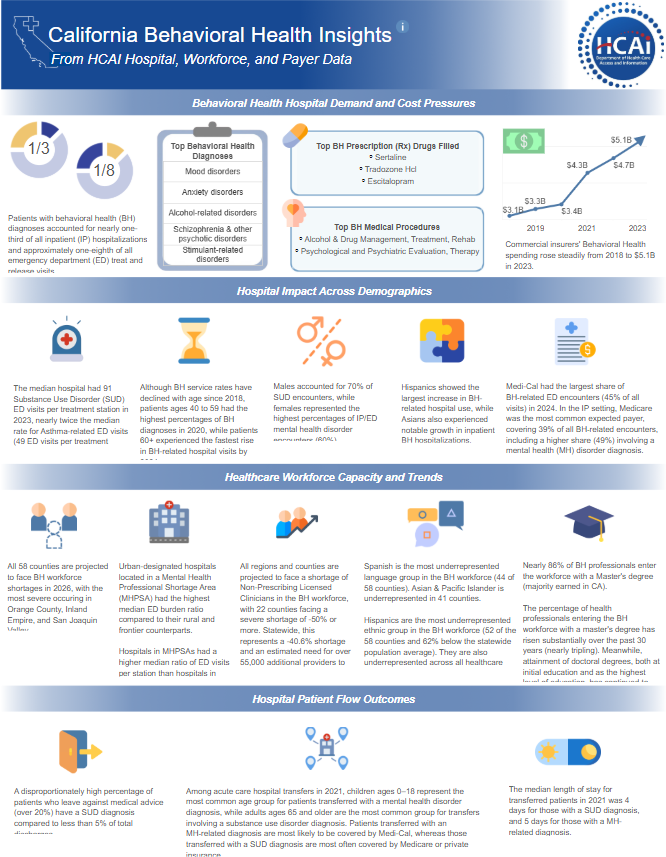
California Behavioral Health Insights is an interactive infographic that provides the most pertinent HCAI behavioral health data. Users are able to explore key findings and themes identified in analyses related to topics such as service volume, costs, patient characteristics, access to care, workforce capacity, and patient outcomes.
This infographic is printable. To print, click the ellipsis icon on the bottom right corner of the infographic and select PDF. (Please note: The hover-over tooltips shown in the interactions cannot be printed.)
Products with Behavioral Health Data
Hospital and workforce behavioral health data is integrated into many featured HCAI data visualization products, across the topics of healthcare utilization, health workforce, and cost transparency. Explore the products below to learn more about how HCAI data provides valuable insights into California’s healthcare system.
| HCAI Data Product | Focus on Behavioral Health | Key Content |
|---|---|---|
| Behavioral Health Providers, Encounters, and Diagnoses in California’s Hospital Inpatient and Emergency Department Settings | High ●●● | Hospital encounters, providers, diagnoses |
| Mental and Behavioral Health Diagnoses in Emergency Department and Inpatient Discharges by Healthy Places Index Ranking | High ●●● | Diagnoses, demographics, expected payer, housing status, encounter setting |
| Alcohol-Related Emergency Department Encounters in California | High ●●● | Alcohol-related ED encounters, expected payer, demographics |
| Inpatient Hospitalizations and Emergency Department Visits for Patients with a Behavioral Health Diagnosis in California: Patient Demographics | High ●●● | Hospital encounters, demographics, expected payer |
| Supply and Demand Modeling for California’s Behavioral Health Workforce | High ●●● | Workforce supply, workforce demand, licensed groups |
| Behavioral Health Spending in California’s Commercial Market | High ●●● | Commercial market spending, service claims, prescription drugs |
| Patients Leaving California Hospitals Against Medical Advice | Moderate ●● | Substance use disorder (SUD), discharges, leaving against medical advice (AMA) |
| Top Five Major Diagnostic Categories (MDC) for California Hospitals | Moderate ●● | Mental Health Professional Shortage Area (MHPSA), Major Diagnostic Category (MDC), hospital encounters |
| Acute Care Hospital Transfers by Major Diagnostic Category (MDC) | Moderate ●● | Major Diagnostic Category (MDC), demographics, expected payer, length of stay, inpatient deaths, leaving against medical advice (AMA) |
| Emergency Department Volume and Capacity by Facility, Health Category and Health Professional Shortage Area | Moderate ●● | Mental Health Professional Shortage Area (MHPSA), health-related topics, ED visits, ED treatment station |
| Hospital Utilization Trends | Moderate ●● | Health conditions, hospital encounters, hospital setting |
| Languages Spoken by California’s Health Workforce | Moderate ●● | Workforce language groups, active licenses, workforce age, survey response rate |
| Race & Ethnicity of California’s Health Workforce | Moderate ●● | Workforce race/ethnicity groups, active licenses, workforce age, survey response rate |
| California’s Health Workforce Education Pathways | Moderate ●● | Active licenses, workforce demographics, education level, education location |
| Healthcare Payments Data (HPD): Medical Out-of-Pocket Costs and Chronic Conditions | Moderate ●● | Chronic condition, payer type, member count, out-of-pocket costs, claim counts |
| Hospital Encounters for Persons Experiencing Homelessness in California: Patient Demographics By Facility | Low ● | Mental Health Professional Shortage Area (MHPSA) |
| Preferred Languages Spoken in California Facilities | Low ● | Mental Health Professional Shortage Area (MHPSA) |
| Healthcare Payments Data (HPD) Measures: Health Conditions, Utilization, and Demographics | Low ● | Condition, prevalence, demographics, payer type |
| Healthcare Payments Data (HPD) Services Report | Low ● | Service rate, demographics, payer type |
| Healthcare Payments Data (HPD) Snapshot | Low ● | Procedures, payer type, record count, prescription drugs |
| Healthcare Payments Data (HPD): Fee-For-Service Drug Costs in California | Low ● | Prescription drugs, payer type, total costs, out-of-pocket costs |
Additional Resources
The continuum of care in behavioral health extends far beyond ED visits and IP hospitalizations. After initial stabilization in the ED or IP setting, patients often transition to outpatient services such as therapy, medication management, and case management to continue their recovery in a less intensive environment. Additionally, community resources like housing support, peer counseling, and substance use programs play a critical role in long-term recovery by offering support and resources as patients reintegrate into their communities. Follow-up care ensures that patients maintain their progress and avoid relapse, often through regular check-ins and preventive programs. For more information on continuum of care, visit the Mental Health for All Initiative, Children and Youth Behavioral Health Initiative (CYBHI), and the Certified Wellness Coach program.